
No holes in these SOX : Scoping BlackBerry finances a labour of love for Northern Ontario native
chunkhow
Jan 7
15 min read
Updated: Jan 14
From Great White North to Big Red Room: Making the Pilgrimage to Waterloo
In the mid 1960s, the University of Waterloo bet big on high tech. It purchased the fastest and most powerful IBM mainframe computer it could find and set it up in a jaw-dropping two-story space called the Red Room. The goal— provide computer science students with the best high-tech hardware money could buy. A second aim was to attract the brightest math and computer science students from high schools across the province and Canada.
For John Fraser, the bait worked to perfection. Born and raised in Sudbury and the small mining town of New Liskeard, ON, on the shores of Lake Temiskaming, he fell in love with computers during high school classes led by an innovative teacher named Tom Wells. But it was a weekend bus trip to use the giant IBM 360/75 in Waterloo that really sold Fraser on UW. It was a six-hour journey, much of it on bumpy two-lane highways that snaked through northern Ontario in the early 1970s. But Wells, a UW grad himself, was determined to show his students what real computing power could do. On New Liskeard High’s antiquated key-punch machines, students could run only one card deck per day to get their programs to work. On the powerful 360/75 in Waterloo, they could whip through 100 per day. “It was just phenomenal,” recalls Fraser. “It was progressive thinking on his part,” he says of his teacher.

The other big selling point was UW’s trail-blazing co-op program, which alternated study semesters with work terms, so students could gain practical knowledge and earn money at the same time.
The plan was never to go to UW. His dad graduated from Queen’s University in Kingston, worked as a mining engineer at Inco in Sudbury, then taught at the Haileybury School of Mines near New Liskeard. “It broke his heart when I didn’t go to Queen’s.”
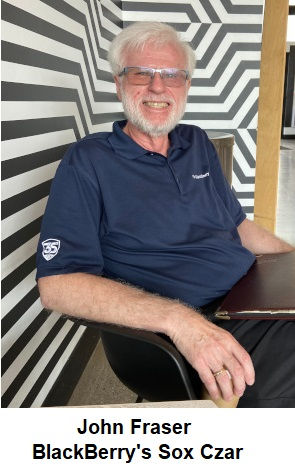
The five years he spent at UW from 1974-79 studying accounting and computer science vaulted Fraser into a “fascinating” 40-year career spent largely at two companies—Sun Life and BlackBerry. The BlackBerry experience in particular is one he takes much pride in. “We were on a mission when I joined the company. We were changing the world.” During our interview, he wore a navy blue BlackBerry golf shirt, still in pristine condition even though he retired three years ago.
Among the many people who worked at BlackBerry during the parlous 2012-16 period, Fraser is somewhat unique - he survived it. At that time the plummeting sales of its flagship smartphone pushed the company into free-fall; Blackberry’s future was in jeopardy and thousands of its employees were laid off, but when the debris settled Fraser was still standing. You might call him the Keith Richards of BlackBerry. Nothing could kill him.

His superpower? Fraser was the head of the SOX compliance team - a crew tasked with the obligatory revamping of Blackberry’s auditing and financial reporting regimen. Despite its homophonic name, SOX compliance has nothing to do with enforcing acceptable workplace footwear, but the metaphor is appropriate. It does have everything to do with pulling up one’s socks in the sense of financial transparency.
SOX is the acronym for the Sarbanes-Oxley Act, passed by the US government in 2002 to tighten regulations in the stock market after a wave of financial scandals involving publicly traded companies such as Enron, WorldCom and Tyco International. Shareholders lost millions. Named after Senator Paul Sarbanes and Congressman Michael Oxley, sponsors of the bill, it was aimed at cracking down on problems such as company auditors failing to expose financial irregularities, stock analysts promoting questionable stocks, firms not properly expensing stock options, audit committees failing to curb board of director abuses and banks lending funds to risky firms.
In the case of Enron, a Houston-based energy company, the firm transferred some of its biggest liabilities off the books to prop up its share price. Its accounting firm Arthur Andersen failed to blow the whistle publicly on this practice. The ensuing scandal triggered the demise of both companies. In the wake of such abuses, the Sarbanes-Oxley Act forced all publicly traded companies to set up SOX compliance teams. Other countries, including Canada, soon followed suit.
Fraser was tapped to join BlackBerry’s SOX team in 2007, but it all happened quite by accident. After graduating from UW in 1979 with an honours degree in math, he spent a short time commuting to Hamilton to work at the accounting firm Coopers and Lybrand (now PwC). Meanwhile, his wife Pamela, a fellow math student whom he had met at UW and married in 1979, was working at the Mutual Life Assurance Co. in Waterloo. (Mutual Life demutualized and became a publicly traded company in 1999, changing its name to Clarica. Clarica was acquired by Sun Life in 2002.)
Through his wife, Fraser landed a job in the audit department of Mutual Life with a focus on computers and IT (information technology). Fraser describes his main skills as accounting, auditing and IT. “It’s numbers and the integrity of numbers.”

For the next 25 years, Fraser stayed at Sun Life, moving up through the ranks. Life was good. Both he and his wife could walk to work. They raised two children. The company had a solid defined benefit pension plan. His work was in two areas he loved, audit and compliance, including his first experience with SOX. He planned to ride out the job until retirement. “When you’re with an organization for 25 years, it grows on you.”
Pulling Up Biovail's Sox and Rolling Up to RIM
In 2005 John Fraser's world was turned upside down. Sun Life reorganized its auditing department. Fraser wasn’t part of the new plans. “They asked me to leave.” Suddenly at loose ends, Fraser managed to land a contract job doing auditing and SOX-compliance work at Manulife in Waterloo. Seven months later, he found a permanent job at Biovail, a pharmaceutical company based in Mississauga led by the colourful CEO Eugene Melnyk, who also owned the Ottawa Senators NHL hockey team.
The opening came because Biovail, whose shares were listed on the Toronto and New York stock exchanges, had set up its own SOX compliance team and needed skilled people to join it. Fraser was tapped. He called it “the wild, wild west”, not a phrase often associated with accounting.
There was never a problem with the pharmaceutical side of the business, Fraser noted. But there were issues on the financial end. In 2006, Biovail sued a hedge fund and a stock analysis firm, alleging they published false reports about Biovail. The company[i] later settled that suit and apologized. In 2008, it was sued by the Securities and Exchange Commission in the U.S. over allegations that it overstated earnings, concealed losses and misled investors. Biovail settled that suit for $10 million US. And in 2011, the Ontario Securities Commission banned Melnyk from holding senior roles at Canadian public companies for five years and fined him more than $1 million US.
The back-end administrative systems at Biovail were put in place before SOX became law, Fraser explained, but without considering all the risks. “The SOX program highlighted a number of issues that needed to be resolved in short order,” he said. “This didn’t make Biovail unique—almost all companies governed by SOX had similar challenges.”
The problems at Biovail notwithstanding, Fraser already had his eye on another company. By this time, Research In Motion (RIM), as it was called originally, was the toast of the international business and high-tech world, thanks to its wildly popular BlackBerry smartphone.
Sales of the handheld device, which debuted in 1999, had soared to 6.4 million a year in fiscal 2007, up from four million the previous year. RIM boasted eight million subscribers in 110 countries on more than 270 carrier networks. Annual revenues had leapt 47 per cent in the past 12 months to $3.04 billion US, and the company boasted a workforce of 6,250 employees, a jump of 1,500 from 2006.[ii]
Those were just the numbers. The anecdotal evidence was even more striking. Al Gore had used a BlackBerry during his 2000 presidential campaign. Oprah Winfrey declared the BlackBerry one of her favourite things in 2003. Time magazine had named the phone one its top ten gadgets of the year. RIM co-founder and co-CEO Mike Lazaridis, inventor of the BlackBerry, appeared in an American Express TV commercial in 2005. The phone was so addictive it was nicknamed the “CrackBerry.”

“By 2005, BlackBerry was on a roll,” said Fraser. Even so, chinks were beginning to show in RIM’s armor. The company had taken too long to settle a punishing patent lawsuit in 2006 that eventually cost it more than $600 million US and nearly shut down sales in the U.S. That same year, RIM along with other publicly traded firms was caught in an embarrassing scandal over the backdating of stock options to make them more valuable for employees, a practice that would later result in heavy fines for Lazaridis and co-CEO Jim Balsillie and the latter stepping down temporarily from the board of directors.
If 2006 was a year of courtroom drama for RIM, 2007 witnessed a nascent marketplace challenge as competitor Apple debuted its game changing iPhone. The coming threat flew under RIM’s radar as sales of the new gizmo would not gain traction until 2008 as customers didn’t know what to make of the strange touchscreen. Also, Balsillie was preoccupied with scoring an NHL franchise when many thought he should be keeping his eye on the core business.
All the same, Fraser was keen on landing a job with the BlackBerry-maker. After all, it was based right in his hometown of Waterloo. He might once again be able to walk to work. While doing the contract job at Manulife, his boss had left for a job at RIM but found that the position was not to his liking, so he quit and mentioned Fraser as a possible replacement. Even with that endorsement, he had a tough time landing a job. “BlackBerry was hiring so many people; it was hard to get their attention.” A lengthy recruitment process followed including phone interviews, in-person interviews and reference checks. Finally, after several months of waiting, he joined the company in August 2007.
At the time, the SOX department at RIM was divided into two teams. One was responsible for IT, the other for business. Fraser was assigned to the former. “Ultimately I became leader of the whole group.” The department was small, only six or seven people in total, including one co-op student. Students were hired from the business program at Wilfrid Laurier University or the MMI (Master of Management of Innovation) program at the University of Toronto.
With SOX being a new field, there were no formal university or college programs or textbooks. Instead, Fraser attended special education sessions organized by audit and accounting associations. Companies also hired separate audit firms to advise them on how to comply with the SOX legislation.
One of the main tasks of the SOX team was to produce an annual report of sorts that Lazaridis, Balsillie and other senior executives could sign off on attesting that the company’s finances were free of “material error.” To produce the report, the team would conduct a 12-month review, repeated every year, of all the processes and governance activities at RIM (the company was renamed BlackBerry in 2012).
“It was a fascinating trip across the organization,” said Fraser, who worked primarily out of the company’s offices on Northfield Drive in Waterloo. In the course of the review, Fraser and his team talked to personnel across a wide swath of the company—everyone from accounting and IT to payroll and purchasing. “Most of the finance functions were within my scope.” Even the manufacturing process came under their scrutiny. The making of the devices was important to the accounting process so they had to understand how they were put together.
And they didn’t just talk to junior or mid-level people. Doors were opened to the highest ranks of the company, including executives in the C-suite: the chief executive officer, chief financial officer, chief technology officer, etc. “It was a tremendous role in the organization, very interesting stuff.” In the early days, Fraser was thrilled to be working at the company. “People were coming from all over the world to work at BlackBerry. Just tremendous talent.”
Just watching it all unfold from the inside was mind-boggling. “Mike (Lazaridis) would say we are going to create a device, it’s going to be ready in a fairly short period of time.” Then the BlackBerry machinery would kick into gear starting with hardware design, supply chain management and manufacturing in distant plants to marketing, global rollout and selling to hundreds of carriers. “Just the whole process of bringing all the components together. I mean wow!” Fraser said.

In the course of their work, Fraser and his team would review the previous year’s financial statements, including income statements, balance sheets and notes, and identify numbers of interest to SOX and the source of those numbers. Generally the source fell into two categories: those produced by a system or those resulting from a manual process.
If the source was a system, the next step would be to pinpoint the business process. Did it come from revenue, accounts payable, human resources, inventory or somewhere else? To answer that question, the team had to work with a large, customized computer system made by SAP, the giant German company that supplied BlackBerry’s main business software platform. Fraser called it a “scoping exercise.” Because the scoping process was expensive, the goal was to isolate only the SOX data and nothing more, he said. If the number emerged from a manual process, the aim would be to identify the people responsible for that process.
Once the scoping exercise was complete, the SOX team would identify potential risks and work with relevant personnel to develop internal controls to manage or eliminate those risks. If the risk involved an IT function, they looked for two kinds. The first occurred if code changes to the SAP system didn’t work as intended. The second if an employee made an unauthorized change to the system. The latter risk would be prevented by ensuring that more than one person was involved in the process.
If the risk fell on the business side, the dangers were more varied. For example, how did BlackBerry know if every smartphone sale was billed to a telecom company? How did it ensure pay cheques were stopped when people left the company? Or what prevented a supplier’s invoice from being paid twice?
Once a system of internal controls was developed and put into place, all would be good, right? Not necessarily. Controls ran into the hundreds. It was impossible to make them all bullet-proof. If a control wasn’t working it was assigned one of three labels, depending on the severity of the issue. The first, called a deficiency, was considered minor and unlikely to produce an error in the financial statements. The second, called a significant deficiency, required more immediate attention. The final label, “a material weakness,” generated a code-red alert. It was “a very big deal and needed to be disclosed to the board of directors and the investing public,” said Fraser. The goal was to avoid a material weakness at all costs. Were there any during Fraser’s stint as SOX team boss? He was reluctant to get into any details but suffice to say there were no issues on the order of BlackBerry’s stock option scandal of 2006. His work was a "SOX-cess," it seems.

Public companies are required by law to have their statements audited by an outside company so why bother with SOX? Wasn’t it redundant? Not according to Fraser. It’s hard to hold auditors accountable if they are the only ones checking financial statements. The value of SOX is that it “emphasized the need to segregate duties so that no one had complete control over a transaction,” he noted. Most firms maintained a system of internal controls, but few documented them and tested them annually with the rigor demanded by SOX, Fraser noted. “The SOX legislation set a very high bar and it was expensive.”
Fraser's role was to hire “great people, train them and coach them” and ensure everything ran smoothly. If constantly perusing numbers and documents sounds like it would produce one giant headache, such was not the case. “It was a great role and I loved every second of it,” he said. Fraser was a “real steady hand on the tiller at a time of constant change,” said Steve McMichael who worked on the BlackBerry SOX team for five years. BlackBerry was always doing something different such as acquiring a company, switching software to the cloud or divesting a business. “Every year was like open-heart surgery,” noted McMichael.
The SOX team not only had to have a firm grasp of the minutiae of business and finance but it also had to know its way around a variety of software platforms. In addition to SAP, there was NetSuite, Salesforce and Workday, he said. “Our team managed hundreds of controls, and John reviewed all of them in detail with review notes. That was impressive.”

Another challenge was rigid financial deadlines. You can change a product deadline, but you can’t move a quarterly earnings call, said McMichael. “In that environment, there’s no calling in sick.” The team had an annual mountain to climb—compiling the SOX annual report. “There was no being late.” Despite the pressure and disruption, Fraser was unflappable. “He was very calm in the face of adversity,” added McMichael. Around the office, Fraser was never without a cup of coffee and an armful of documents. “You’d come in on a Saturday and he would just quietly be there with coffee and a stack of papers,” McMichael said with a laugh.
SOX compliance doesn’t get the respect it deserves, in his view. McMichael credits it for advancing his career to the point where he is now director of governance, risk and compliance at BlackBerry. “It’s pretty underrated, but a pretty cool space.” Fraser also gave his team a chance to grow. When Shreya Savanur wanted to boost her IT skills, Fraser did his best to give her work on platforms such as Salesforce and NetSuite. “John taught me a lot of things that I took forward,” she said.
Fraser also felt it was important to get to know his staff outside work. He invited team members to his home for Christmas lunch and visited them at their homes during Covid. “Sometimes bosses just keep work at work. It was nice to get to know him as a person as well,” said Aman Gill, another SOX team member. When her father died in India in 2022, Gill remembers crying on the phone as Fraser listened sympathetically.
Savanur, who joined the SOX team as a co-op student, was making a final presentation for her master’s degree at the University of Toronto. Fraser gathered other members of the team and drove to the Mississauga campus to hear it. “We really felt like a tight-knit family,” Savanur said.
For the first few years of Fraser’s employment at BlackBerry, its future looked promising. “2008 was a big deal. We were the top of the heap, the most valuable company on the TSX,” said Fraser. But then things started to unravel. The iPhone caught fire in 2008, and Google, anxious to get its search engine on mobile devices, unveiled a software operating system that hardware companies such as Motorola, Samsung and HTC could use in their own touchscreen devices.

Meanwhile, RIM tried some fancy footwork. Instead of rushing out a viable touchscreen, it released a hybrid device that married the touchscreen with a physical keyboard. When users pushed a button on the keyboard underneath the screen they felt a physical click. Called the Storm, the handset was plagued by problems and flopped in the marketplace.
The company fell back on its existing suite of BlackBerrys, some with normal touchscreens, to stop the bleeding but RIM was hobbled by an aging software operating system that struggled to match the rich features of rival touchscreens. It pinned its hopes on a new operating system created by QNX, a company it acquired in 2010. But RIM took too long to release the new QNX phones, called the Z-30 and Q-30. When they hit stores in 2013, the iPhone and Google phones had the market locked up.
More phones followed including the BlackBerry Passport with square corners, but they failed to stick with customers and the company, led through much of this time by CEO John Chen, exited the phone market altogether in 2018.[iii] At one time, BlackBerry employed 20,000 worldwide with annual revenues of $20 billion US. Now it employs around 1,800 with annual sales of $535 million US.[iv] BlackBerry is now exclusively a software company specializing in cyber-security and wirelessly connecting cars and machines.
As he watched many of his co-workers leave, Fraser worried about losing his job. “We were always at risk. I tried not to worry about it too much. You couldn’t control it.” One of the hardest parts for Fraser was watching co-workers lose their jobs. “These weren’t just names. These were people I had worked with. That was part of the heartbreak.”
At the same time, he was reassured that BlackBerry was required to have a SOX team. Many companies outsourced their SOX work, but BlackBerry decided it was more efficient to keep the team in-house.
In the meantime, his job became more challenging. “The risk profile of the organization went up as we were downsizing. More things could go awry.”
In the good times, BlackBerry grew so quickly that new employees did not properly document their work. “It was all in people’s heads, how you did stuff.” Then all of sudden, they were let go. “You had these gaps in knowledge and there was a lot of scrambling.” The team tried its best to anticipate future cuts and close those gaps. “We would jump on it fairly quickly and talk to senior people and say ‘you have an issue here. You need to get on it.’ ”
Fraser actually planned to retire a few years earlier than 2022, but the company changed auditors from Ernst & Young to PwC in 2019. “It was going to be a difficult transition. I thought I could help.” Then the pandemic hit in 2020. “If I was going to be at home, I might as well be paid for working at home.” During Covid, his typical day involved a blur of online meetings. “You’d wake up and you’ve got zoom call after zoom call.” Yet there wasn’t much choice. “You had to get the job done, so bear down.”
In retirement, Fraser enjoys doing financial work on a volunteer basis for the United Church, of which he is a member, and spending more time with his family, which includes a son and daughter and two grandsons.
Looking back on his career, he wouldn’t change a thing. “I’d do it all again. I loved it.” Apart from working hard and following one’s passion, he has one other piece of advice: “It’s who you know, so build those relationships.” Though BlackBerry is much smaller than it used to be, it remains one of the largest tech companies in Waterloo Region. Fraser still follows the company quite closely. “I still know people there. I wish them all the best.”
How is SOX faring more than 20 years after enactment? Critics complain that it places an expensive burden on public companies, especially startups, and deters some from going public or prompts them to list shares on foreign stock exchanges. Over the years, the US Congress and the SEC have gradually exempted more categories of companies from complying with SOX, based on their public float of shares or their revenues. With U.S. President Donald Trump urging a reduction in red tape, Congress is exploring raising the threshold for SOX compliance from $250 million to $500 million in annual revenues.
[i] Biovail was acquired by Valeant Pharmaceuticals in 2010.
[ii] Research In Motion annual reports, 2006 and 2007.
[iii] BlackBerry stopped supporting software on legacy devices in 2022.
[iv] BlackBerry annual report, 2025


Comments